
Education by GotCredit (CC BY 2.0)
For my first blog post of ALM 201, I would like to share my experience with gamification using in education.
Firstly, I need to explain what gamification is. According to Bosomworth (2011), gamification is “the process of using game thinking and mechanics to engage an audience and solve problems”. In my own understanding, gamification include some key elements, the image below is the infographic that I made by myself.
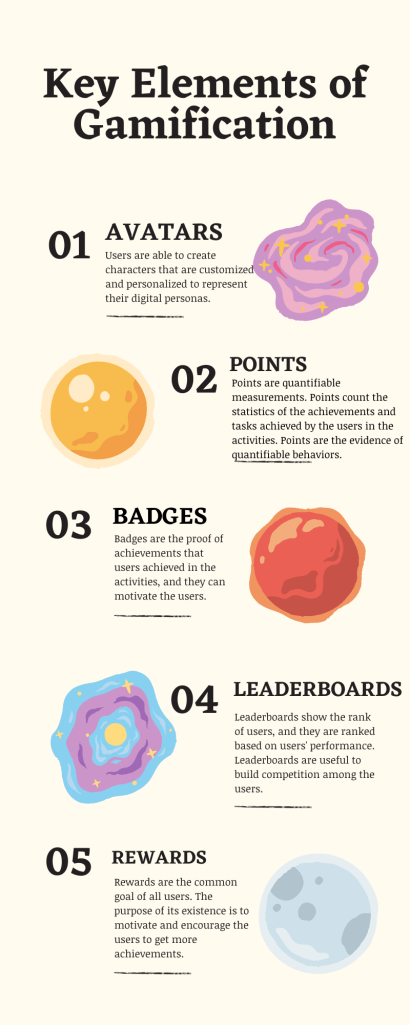
As the infographic shows, there are 5 key elements of gamification, which are avatars, points, badges, leaderboards and rewards. According to Dichev and Dicheva (2017), gamification used in education is in order to encourage the students’ motivation and engagement by applying game principles to the learning environment.
After uderstanding what gamification is and why it can be used in eductaion, I would like to share my own experience of gamification in education.
As I mentioned in the first assignment of this course, my first experience with gamification used in education happened when I was in kindergarten. When you see the word “kindergarten”, you may understand what kind of experience that I am going to write. Yes, I think most people know that teachers in kindergarten always play some games with kids while they are teaching some knowledge. That is what I want to share. When I was in kindergarten, at that time, most kids did not like math, because they thought math is complex and difficult to learn. So, our teacher taught us math by playing some simple games with us, this is in order to motivate our participation and interest about math. The teacher asked us question, and we answered by raising one of our hands. The kid who raised his/her hand the quickest and answer the question correctly would get candies as rewards.
Even now, I am studying in university, some teachers still use the way of rewarding candies by answering questions to motivate our enthusiasm for learning, and also playing some small games with students in the class. Also, in this course, we use Twitter to communicate and study, we can share our mood while we are studying by using some interesting gifs or videos, and we can also create some infographics about specific knowledge. These can also be regarded as gamification in learning if you think a “like” to your tweet from your teacher and classmates is a kind of rewards. I do believe using gamification in education is a good way for teachers to teach students.
Reference List
Bosomworth D (26 July 2011) ‘Gamification – what is it and why is it important?‘, SmartInsights, accessed 26 April 2021.
Dichev C and Dicheva D (2017) ‘Gamifying education: what is known, what is believed and what remains uncertain: a critical review’, International Journal of Educational Technology in Higher Education, 14(9), https://doi.org/10.1186/s41239-017-0042-5
GotCredit (16 January 2019) Education [photo], Flickr, accessed 26 April 2021. Available under Attribution 2.0 Generic (CC BY 2.0).
 yolandaguo