ALM101DC Assessment Portfolio Outpot 2

The topic of this podcast is to illustrate the benefits and the limitations of digital media use in education.

The first step to create this podcast is definitely to make a plan. I divide this podcast into seven parts. The first part of this podcast is 10-second music, which is the beginning of the podcast. I think using music at the start of the podcast can make my listeners feel relaxed and be more interested in what I will talk about next. The second part of this podcast is a brief introduction of myself and my topic. This part is necessary for creating a podcast, because I need to tell my listeners my name in order to let them know who the creator of this podcast is. I also need to introduce what topic that I am going to talk about in this podcast. The third part of my podcast is to explain my topic. In this part, I explain the term ‘digital media’, I think this is an academic word, so I use a scholarly source to examine its definition. The following part is to list the examples of advantages of digital media use in education. I use a scholarly source in this part, because I need evidence to show that using digital media in education has some benefits. The fifth part of my podcast is to show some examples of limitations of digital media use in education. I reference a scholarly source in this part in order to indicate the evidence which proves that using digital media in education also has some limitations. The next part is a conclusion of my podcast, and this is also a necessary part of a podcast. I need to summarize what I said, and I also ask some questions such as ‘Will digital media replace teachers in the future?’ in this part, which can make my listeners think about the future of digital media use in education. Then the final part of my podcast is 15-second music.

Before I create my podcast, I need to find some scholarly sources to reference. I found one e-book, one journal article and one music. The e-book was used to explain my topic. As I wrote before, my topic has an academic term ‘digital media’, which I think needs to be defined. When I was referencing this book, I paraphrased the original work of the definition of digital media written by the author. I used my own words to explain what exactly digital media means. The journal article that I used was to provide the evidence for the advantages and limitations of digital media use in education. In the journal article, there is a research about digital media using at school. I read the research and the results of this research, then I concluded the findings. Most of the benefits and limitations are the ideas I thought, so I added the findings of the research in the journal article to these two parts, which can make them be more convincing. The music I choose is a creative commons licensed music, so it can be used in my podcast. The name of this music is ‘Happy’, I choose it because I think it can make my listeners feel energetic and be more willing to listen to my podcast.

I met some challenges when I was creating this podcast, and I did learn a lot from them. For example, when I was editing my audios, I had no idea about how to use ‘Audacity’. Then I solved this problem by searching the use instructions online. For another example, I found that the format of my audio recording was not mp3, I also searched online about how to solve this problem, then I found the way to transfer the format of my audios.

This is the first time that I create a podcast, and I think it is a good experience.

Reference List

Cinque, T 2015, ‘What is the Media, and is Digital media ‘New’?’, in Communication, Digital Media and Everyday Life, 2nd ed., Oxford University Press, pp.16-18, retrieved 19 January 2020, <https://ebookcentral-proquest-com.ezproxy-f.deakin.edu.au/lib/deakin/detail.action?docID=5402107>.

Davis, K, Ambrose, A & Orand, M 2017, ‘Identity and agency in school and afterschool settings: Investigating digital media’s supporting role’, Digital Culture & Education, vol. 9, no. 1, pp.32-44, retrieved 21 January 2020, <http://katiedavisresearch.com/wp-content/uploads/2014/01/2017.DigCulture.identity..pdf>.

‘Happy’ released by MBB (CC BY-SA3.0), https://soundcloud.com/mbbofficial/happy
ALM102DC Assessment Artificial Intelligence

The topic of this video is artificial intelligence, which is similar to the topic that I choose in assessment 2. However, in this video, I explain artificial intelligence in more detail. I divide the video into six parts, including a hook, the meaning of artificial intelligence, some applications of artificial intelligence, what benefits that AI’s applications bring to people and what potential risks that AI has, plus a conclusion. The key purpose of this video is to let my audiences understand exactly what artificial intelligence is through its applications, advantages and risks. Especially its advantages, which are the main reason why artificial intelligence can spread such quickly today.
In order to make this video, the first step is definitely to make a plan, and it is about what contents that I am going to put in my video. I decided to divide this video into six parts. The first part is to start the video with a hook, which can make my audiences be more interested in what this video will show to them. So I choose a Chinese movie as the hook, which is called ‘The Wondering Earth’. I put a short video cut of this movie at the start, and then I explain why I show this video cut. In this movie, there is a robot and its name is Moss, which is related to my topic because Moss is created by using artificial intelligence.
Then in the second part of my video, I explain what artificial intelligence is. I search it in the website of our school’s library, and I find two books which describe the definition of artificial intelligence clearly. So, I use them to explain the meaning of AI in my video. I used my own audio that records the content in the books, which is about the meaning of artificial intelligence, with some pictures and a background music that I searched on the Internet.
After that, I combine the third part and the fourth part of my video together, which are the applications of artificial intelligence and how these advantages make AI spread such quickly today. In these two parts, I introduce three applications of artificial intelligence, which are Siri in iPhone, Google Map and Alipay in China. All these applications can show the benefits that AI can bring to people. Firstly, we can ask Siri a lot of questions in our daily life, such as the weather. I use a forum article that describes how Siri works as the reference in this part. Secondly, we can use Google Map to guide us to a place that we may have never been there before, and it can show us the clear route and can also tell us how to get there by using different vehicles. Thirdly, we can use Alipay in China to pay for the bill, so we do not need to take cash with us when we are shopping, which is really convenient. I use a short video cut that shows how Alipay works and also a news article that explains how Alipay makes many Chinese people do not use cash today.
The fifth part is to illustrate what potential risks that AI has. In this part, I conclude the content of a TED Talk, which talks about what will happen if artificial intelligence becomes smarter than human and lose control. I also add my own opinion of the potential risks that AI may has, which is AI may cause people lose their jobs in the future, such as teachers and bank assistants.
Then the last part of my video is a conclusion, which is artificial intelligence does bring us many benefits, however, it also has some potential risks that we may pay attention to.
I found many problems while I was editing the video. For example, I think the shots that I talk to the camera have an obvious problem, the shots are shaky because my hands are shaking when I am talking. This is an aspect that I should pay attention to. I also found that the explanation part of artificial intelligence’s meaning is a little bit long, so it may cause my audiences to feel boring when they are watching it. This is another aspect that I should pay attention to. I also learned a lot during the making process of this video. For instance, I didn’t know how to combine my own voice and the music I found on the website together. Then I searched the question online, and I found the way to solve this problem quickly.

Reference List
Marr, B, 2019, Are Alexa and Siri Considered AI?, Bernard Marr & Co: Intelligent Business Performance, retrieved 9 January 2020, https://bernardmarr.com/default.asp?contentID=1830.

Barr, A, & Feigenbaum, E, 1982, The Handbook of Artificial Intelligence, William Kaufmann, Inc, Vol. 2, retrieved 9 January 2020, https://books.google.com.au/books?id=xP7iBQAAQBAJ&lpg=PP1&dq=artificial%20intelligence&lr&pg=PP1#v=onepage&q=artificial%20intelligence&f=false.

Nilsson, N 1980, Principles of Artificial Intelligence, Morgan Kaufmann, retrieved 9 January 2020, https://books.google.com.au/books?id=mT-jBQAAQBAJ&lpg=PP1&dq=artificial%20intelligence&lr&hl=zh-CN&pg=PP1#v=onepage&q=artificial%20intelligence&f=false.

What happens when our computers get smarter than we are? | Nick Bostrom 2015, YouTube, TED, 28 April, retrieved 16 January 2020, https://youtu.be/MnT1xgZgkpk.

Wibawa, T 2018, ‘Alipay and ‘zero-dollar’ packages: How Chinese tourists are reshaping tourism around the world’, ABC News, 2 December, retrieved 9 January 2020, https://www.abc.net.au/news/2018-12-02/how-chinese-tourists-are-reshaping-tourism-around-the-world/10557512.

THE WANDERING EARTH Trailer 2019, YouTube, Cycanches Channel, 20 March, retrieved 19 January 2020, https://youtu.be/Z6C8ZTIUY1s.

Alipay: Anywhere, any time 2016, YouTube, NANDO RAMOS, 12 December, retrieved 19 January 2020, https://youtu.be/YQ61Owxb_EM.

‘Happy’ by MBB is licensed under CC BY-SA 3.0, https://soundcloud.com/mbbofficial/happy
https://images.app.goo.gl/LWqMGvwXj54mkscG7

https://images.app.goo.gl/fAtb37kbjmcRP7tR8

https://images.app.goo.gl/yUJT6DceKmgHsu8j7

https://images.app.goo.gl/zKTVwyuAQFBxoyqw6

https://images.app.goo.gl/u3nzAW2mFt2nGGCe8

https://images.app.goo.gl/YFNgwQdp7ueGrsaA6

https://images.app.goo.gl/EnLpLov3nC4jVM8w6

https://images.app.goo.gl/rsAq6d9AYh2oxdux8

ALM102DC Assessment 2 Artificial Intelligence

The topic of this video is AI, which means artificial intelligence. In this video, I introduce AI in three parts, including its meaning, what kinds of applications it can be used in, what benefits it brings to people and what potential risks it has. The meaning of this video is to let people understand exactly what artificial intelligence is through its applications, advantages and disadvantages.
In order to make this video, the first step is definitely to make a plan, and it is about what contents that I am going to put in my video. I decided to divide this video into three parts. The first part is to explain what artificial intelligence is. I searched it in the website of our school’s library, and I found a book which described principles of artificial intelligence. So, I used it to explain the meaning of AI in my video. I used my own audio that records the content in the book, which is about the meaning of artificial intelligence, with some pictures and a background music that I searched on the Internet. Then the second part is to introduce some applications of AI. In this part, I use three short videos that I make. In these short videos, I show the applications of AI by using my phone. The last part of this video is to illustrate what benefits that AI brings to us and also what potential risks that AI has. The benefits part is actually included in the applications part, because the applications that I showed displayed the advantages of AI. For the risks part, I searched a video that clearly showed two kinds of potential risks of AI.
I found many problems while I was editing the video. For example, I think the shots that I talk to the camera have an obvious problem, the shots are shaky because my hands are shaking when I am talking. I will pay more attention to this aspect and improve it by buying a tripod to hold my phone for the next time I make the video. I also learned a lot during the making process of this video. For instance, I didn’t know how to add a picture into the video. Then I searched the question online, and I found the way to solve this problem quickly.
I think this video is actually not excellent, but I will learn the editing and filming skills carefully. I will do some improvements in the process of making the next video.

Reference List
Nilsson, N 1980, Principles of Artificial Intelligence, Morgan Kaufmann, retrieved 21 December, https://books.google.com.au/books?id=mT-jBQAAQBAJ&lpg=PP1&ots=hL0lhP4E7p&dq=artificial%20intelligence&lr&hl=zh-CN&pg=PP1#v=onepage&q=artificial%20intelligence&f=false.

Music – Happy Mood by AShamaluevMusic (with no copyright but free to use) https://soundcloud.com/ashamaluevmusic/happy-mood

“Artificial Intelligence & AI & Machine Learning” by Mike MacKenzie is licensed under CC BY 2.0, https://flic.kr/p/2aDXanU

“Artificial Intelligence – Resembling Human Brain” by deepak pal is licensed under CC BY-SA 2.0, https://flic.kr/p/28VrEjE

“artificial intelligence lab” by lance robotson is licensed under CC BY-NC 2.0, https://flic.kr/p/pKEQqQ

“ai-artificial-intelligence-blur-546819” by WCN 24/7 is licensed under CC BY-NC-ND 2.0, https://flic.kr/p/2f2XSmm

“AI ethics and AI risk – Ten challenges” by Risk Bites, https://flic.kr/p/2aDXanU

ALM101DC – ASSESSMENT 2 PORTFOLIO OUTPUT 1

Nowadays, more and more people are using social media. It seems that social media has become a way to communicate with everyone. Social network sites were built on online communication, such as e-mail and Internet chat (Marshall 2010, p.38). This blog will illustrate how I use social media to create my own online identity.

social media’ by Sean MacEntee (CC BY 2.0)

I started to use social media when I was in junior high school. At that time, our teacher suggested us to use social media apps to create a class group. This group was created for us to exchange learning methods. It was my first time that I had a basic understanding of social media. Then I found that social media could be used not only for learning, but also for sharing my life. For example, I can post some pictures about myself, my family members and my friends. I can also use video chat to communicate with friends who are living in other places.

Instagram logo on gradient header’ by Frank Buschman (CC BY 2.0)

After I came to Melbourne, I met a lot of foreign friends. They recommended me some interesting social media apps that I ever used before, such as Twitter, Facebook and Instagram. For this blog, I will focus on describing how I created my Instagram account.

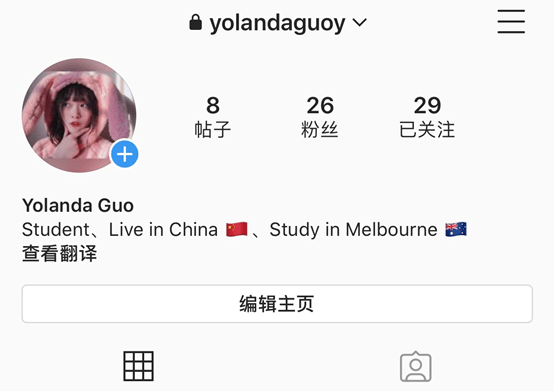
‘Screenshot of my Instagram profile’

When my foreign friends told me about Instagram, I decided to create an account. I chose a selfie photo as my profile picture, and this picture was chosen very carefully. In order to give my followers a good first impression, I chose the most successful selfie I thought I had taken before, which was a picture of me wearing like a rabbit. The reason why I chose a selfie photo as my profile picture was simple. This is my own account, and I think I should at least show myself to others whether they know me or do not know me. I need to let my followers know who I am. Then for the account name, I used my English name and my true family name. I chose to use my English name because this is basically an English version of social media platform. Finally, for the description of myself, I wrote ‘Student, Live in China, Study in Melbourne’, I also added two emojis for the two places contained in this sentence in order to make it look more interesting. These are the basic information about myself, I need to tell my followers where I am from, what job I am doing, and where I am studying.

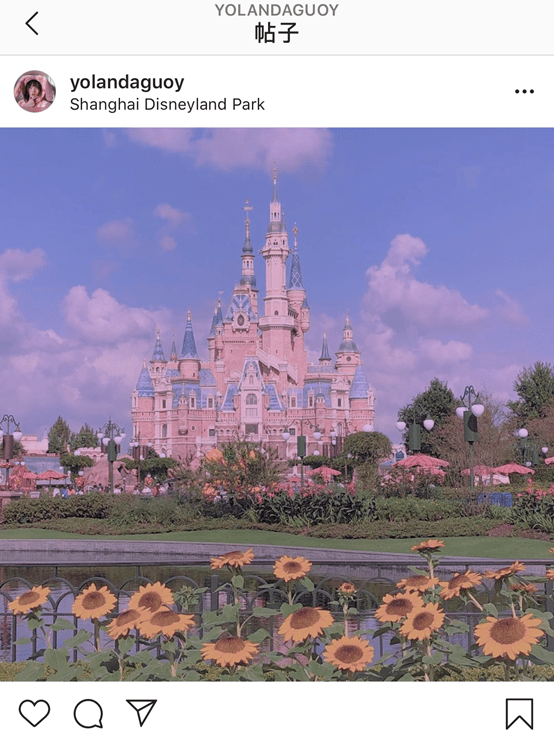
After finishing these steps, my Instagram account was completely created. Then I started to post some pictures that I took during my daily life, such as the place I went and some photos of me and my friends. This is my way to maintain online relationships, I like to show my real life to my followers. As I post some photos, they could do some comments under the post, and I will reply to them. This is actually a kind of online communication.

‘Screenshot of one of my Instagram posts’

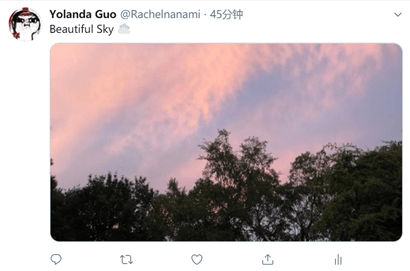
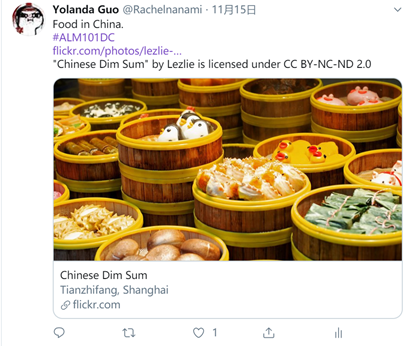
After I entered college, I started to use Twitter for my courses. Then I realized that the use of Twitter is basically similar to the use of Instagram. I can also post some pictures on Twitter, and for myself, the only difference between Twitter and Instagram is that I do not use Instagram for my course needs. The following pictures are the screenshots of two of my tweets.

The first screenshot is a photo of the sky that I took, and I named it the title ‘Beautiful Sky’. This is a photo that I use for sharing my daily life. Then the second screenshot is a post related to one of my courses, and it is also related to my personal interest, which is food. This picture that I posted was taken by the other person, so I provided the link to the original website and also the name of the photographer and the copyright.

However, the use of Twitter is not just posting some pictures. Twitter has been able to capture a slightly different constitution of connection through its short messaging, linking to other sites of interest and becoming part of a more mobile on-line culture (Marshall 2010, p.39).

In the future, I will post many more pictures about my life on Instagram and many more links that is related to my personal interests and courses on Twitter.

Reference List

Marshall, PD 2010, ‘The promotion and presentation of the self: celebrity as marker of presentational media’, Celebrity Studies, vol. 1, no.1, p.35-48, retrieved 15 December 2019, <https://www.tandfonline.com/doi/pdf/10.1080/19392390903519057?needAccess=true>.

Sean MacEntee 2010, social media, photograph, retrieved 15 December 2019, <https://flic.kr/p/8WnyVB>.

Frank Buschman 2017, Instagram logo on gradient header, retrieved 15 December 2019,<https://flic.kr/p/ZUju2c>.

通过 WordPress.com 设计一个这样的站点
从这里开始