
Pile of cash with text Business by Marco Verch Professional Photographer (CC BY 2.0)
Nowadays, gamification has become a popular trend, and it is widely used in a range of industries, including education, business, etc. In this blog post, I will focus on illustrating how exactly gamification works in business and what effects are.
Due to Wünderlich et al. (2019), business gamification refers to relate some game elements with businesses, and it is used to build an interactive relationship between the customer and brands, business gamification can also be used to motivate employees’ engagement. As I listed in the infographic below, the target user of business gamification is not limited to customers but can also be company employees. In the following content, I will provide two examples of business gamification where the target audiences are customers and employees respectively, and these examples can illustrate some of the positive effects of business gamification.
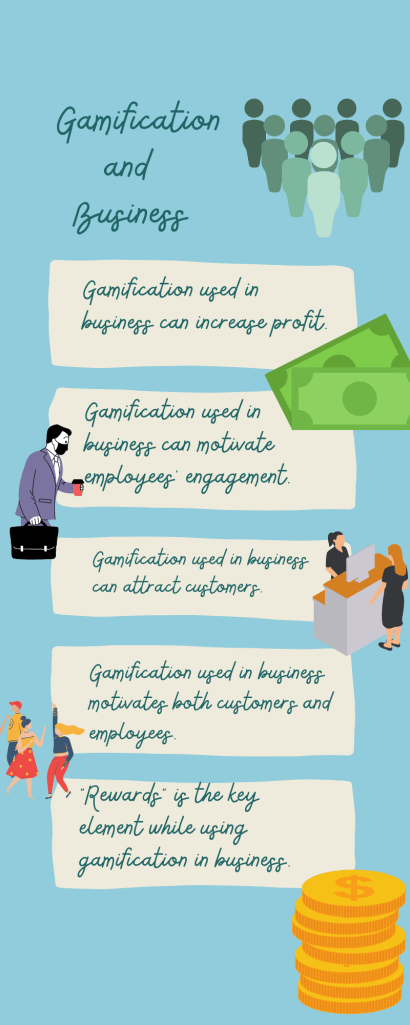
Infographic of Gamification and Business by Yue Guo
The first example is Starbucks, one of the most famous coffee brands in the world. According to Wells (2015), Starbucks can be regarded as one of the best examples of business gamification. The “star system” is the method of business gamification used by Starbucks (Starbucks 2021). If customers register the membership in Starbucks, they will find that they can get one to three “stars” every time they purchase a drink. If customers have accumulated a certain level of stars, they can redeem for rewards, which include free drinks and food. It can be realized that one of the key elements of gamification is used in this case, which is rewards. Starbucks uses gamification to motivate customers’ desire to buy products, and the company can gain profit from it.

Starbucks by Noel Reinhold (CC BY 2.0)
Regarding the effects on employees, due to Brain (2021), gamification “can be used in businesses to enhance employee engagement, marketing efforts, and more”. According to Vinichenko et al. (2016), business gamification is the most effective way to improve employees’ motivation. These two views can be proved by the following example, which is based on my own experience.

bonus by Mike Cohen (CC BY 2.0)
Summarizing my experience briefly, that was the time when I was doing a part-time job in a bakery. My colleagues told me that the owner of the bakery would give them bonuses based on daily sales. There was a set target for daily sales, and if they reached the target, each staff would get the bonuses, but not if they didn’t. So, they were very motivated in their work and were willing to continue working even during lunch break. In this scenario, bonuses can be regarded as the rewards of gamification, and it is proved that business gamification can motivate employees’ engagement and increase their performance effectively (Kanazawa 2019).
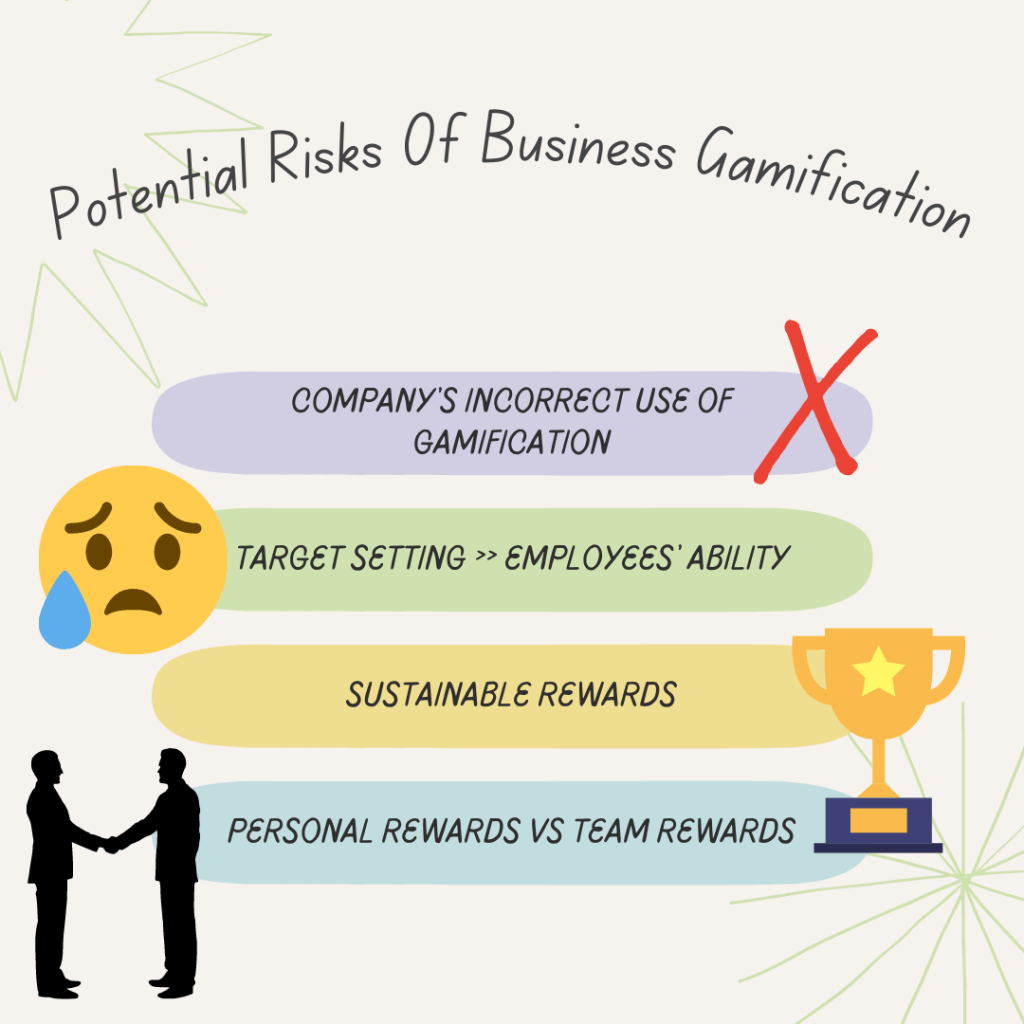
Potential Risks of Business Gamification Infographic by Yue Guo
However, except the positive effects, are there no negative effects of gamification used in business? The answer is yes, business gamification does exist some potential negative effects. According to Callan RC et al. (2015), some of the potential risks of business gamification, including companies using business gamification incorrectly, can lead to a failure in employee training. For example, in the experience I described above, if the set target for daily sales is unrealistic, such as selling 100,000 dollars a day to get bonus, then the problem is shown. This shows one of the potential negative effects of business gamification, which is setting a target to get rewards that is far beyond the ability of employees (Callan RC et al. 2015).
There is another potential risk that cannot be ignored, which is the rewards that company provided need to be sustainable (Callan RC et al. 2015). If employees are used to rewards, their demand for them will increase as time passes. If no new incentives are provided, they will lose motivation. The other potential risk is the destructive competition among the employees. Companies should set goals for individual employees and then give them team goals that require cooperation with their colleagues at the same time. This will avoid that the employees focus only on personal achievements and ignore other overall tasks, and also avoid the possible tension among individuals caused by employees’ competition (Turco 2013).
In conclusion, gamification used in business has both positive and negative effects. Companies should pay attention to use business gamification reasonably and try to avoid potential risks.
Reference List
Brain Cameron (19 January 2021) ‘6 Gamification Strategy Tips for Your Business‘, everyonesocial, accessed 27 April 2021.
Callan RC, Bauer KN and Landers RN (2015) ‘How to Avoid the Dark Side of Gamification: Ten Business Scenarios and Their Unintended Consequences’, in Reiners T and Wood L (eds) Gamification in Education and Business, Springer, Cham.
Kanazawa M (3 September 2019), ‘Using Gamification in Business to Increase Performance‘, mambo.io, accessed 28 April 2021.
Marco Verch Professional Photographer (15 January 2019) Pile of cash with text Business [photo], Flickr, accessed 27 April 2021. Available under Attribution 2.0 Generic (CC BY 2.0).
Mike Cohen (21 July 2018) bonus [photo], Flickr, accessed 27 April 2021. Available under Attribution 2.0 Generic (CC BY 2.0).
Noel Reinhold (4 August 2012) Starbucks [photo], Flickr, accessed 28 April 2021. Available under Attribution 2.0 Generic (CC BY 2.0).
Starbucks (2021) Rewards, Starbucks, accessed 27 April 2021.
Turco K (10 July 2013) ‘It’s Not All Fun and Games; Potential Risks of Gamification’, TechnologyAdvice, accessed 28 April 2021.
Vinichenko MV, Melnichuk AV, Kirillov AV, Makushkin SA and Melnichuk YA (2016), ‘Modern Views on the Gamification of Business‘, Journal of Internet Banking and Commerce, accessed 28 April 2021.
Wells M (20 August 2015) ‘Top 10 best examples of gamification in business‘, MyCustomer, accessed 27 April 2021.
Wünderlich N, Gustafsson A and Hamari J (2019), ‘The great game of business: Advancing knowledge on gamification in business contexts’, Journal of Business Research, http://dx.doi.org/10.1016/j.jbusres.2019.10.062
 yolandaguo